I really hate Alexas… but I also find them really useful.
However, as with all voice assistants: Alexa, Siri, Google Assistant etc. they are not perfect. They make mistakes, mishear, misunderstand and even activate when not even called upon. But even with such frustrating flaws they have all become common place and in some cases even essential to out personal infrastructure. Whether its to turn the lights on, wake you up in the morning or just play they radio, these IOTs have managed to take over. In my opinion the humble light switch has been “betamaxed” by Alexa and her cronies.
To explore this route further, I decided to use Google Teachable Machine, and more specifically, its Audio Classifier functionality.
With the limited timescale of the project and the limitations in training data that I soon encountered, I decided to really lean into the flawed aspects of these “Smart Devices” to come up with an output that was more comical than serious. However, maybe in doing so it becomes more intriguing, sparking a more serious discussion, quite a paradox.
The basic premise was to address the inconsistency of voice detection and merge it with the genuinely debatable humour we have in our Studio. This meant creating a device that would listen to hear certain key words and react to them…
The keywords are: “Syntax error”, “Error” and “Semicolon”. When these words are mentioned, they trigger the raising of a flag, similar to how an IDE flags an error; however, in this case, they are literal flags.
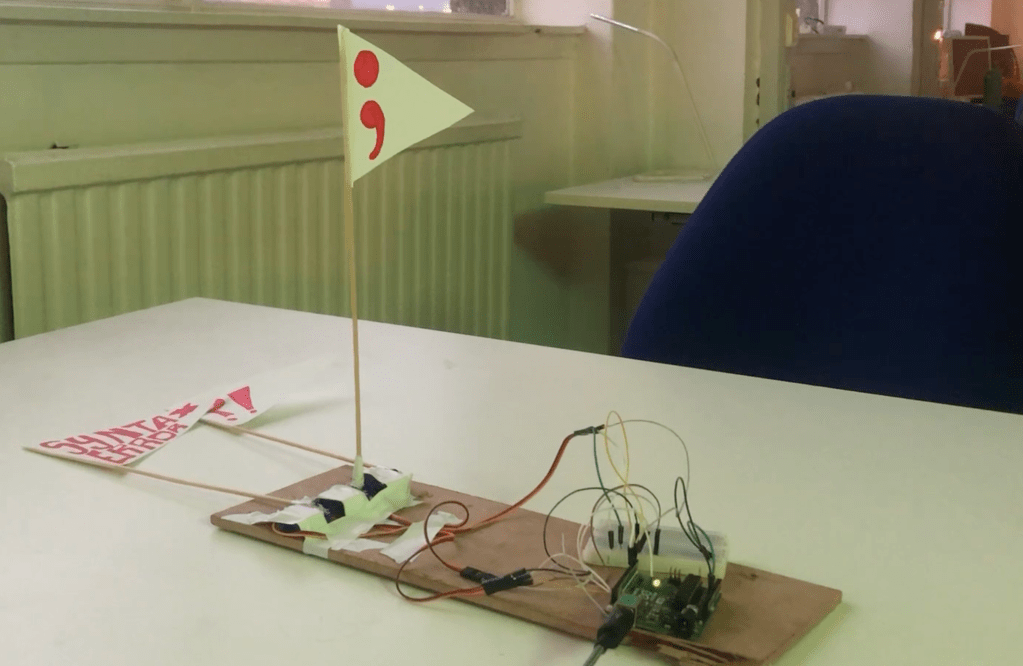
Here you can see the device… its three flags, the servos that control them, and the Arduino in turn controlling them.
I liked the rough and exposed “design”, contrasting the black boxes that sit in our kitchens, going unoticed however, always listening. It also added to the device’s “personality”, giving it character and charm, overall making it even more humorous through ones ablilty to seemingly connect with it on a more emotional level.
Here you can get a better sense of what I am trying to articulate…
Firstly, thanks to Beth and Jack for their wonderful contribution…
In situ, the work hints at the reality of the situation we are in, trusting and relying on these little black boxes that sit on our shelf, in our phone or even clothing accessories. Devices that seem to cause more frustration and raise more questions about our privacy than we ever expected.
 LEARNING JOURNAL